

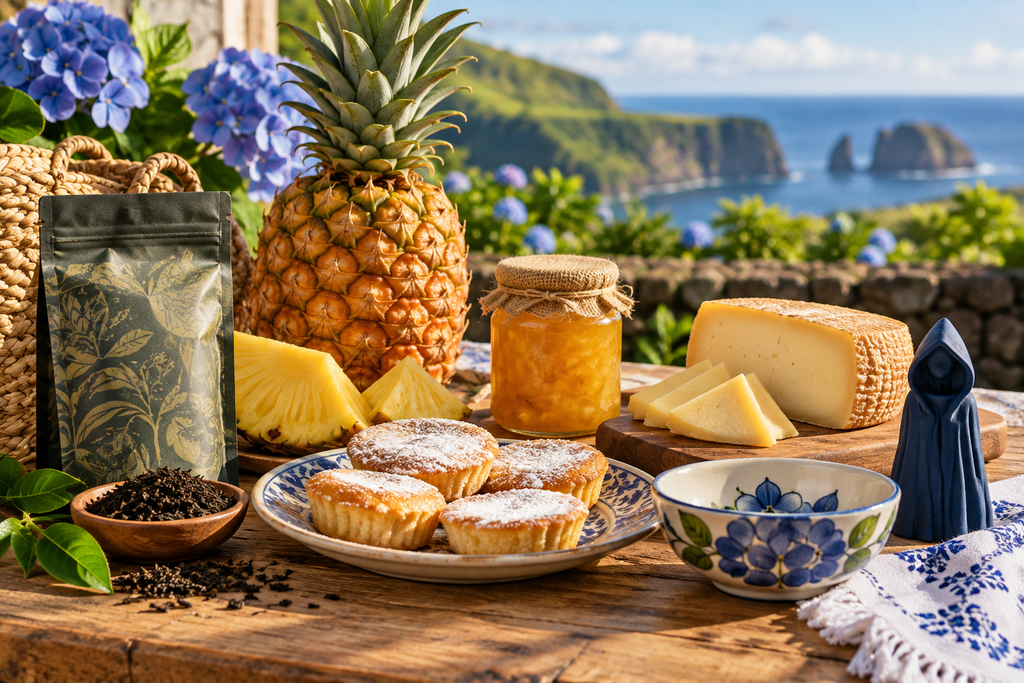
Some souvenirs end up on a shelf. Others keep the journey going for a little longer.
In the Azores, some of the best belong to the second group. A box of tea opened weeks after returning home. Pineapple preserve that takes you back to the greenhouses of São Miguel. A cheese chosen after discovering that each island has its own products and traditions. Or a locally made piece of pottery that remains part of your home long after the holiday photographs have been put away.
If you are wondering what to buy in the Azores, there are plenty of options. But it is worth looking beyond the most obvious souvenirs and choosing products with a genuine connection to the islands — through agriculture, food or craft traditions that remain alive across the archipelago.
And if your trip is to São Miguel, several of them can be bought in the very places where they are produced.
Few purchases combine history, landscape and practicality quite as well as tea grown in São Miguel.
After walking through the tea plantations in the Azores and seeing how the leaves travel from the fields to the factory and finally the cup, taking a packet home feels like a natural continuation of the visit.
Gorreana and Porto Formoso produce tea on São Miguel’s north coast, and different varieties can be bought during a visit. There is also a practical advantage: tea is light, takes up little room and requires none of the transport considerations of fresh food.
It makes an easy gift, although you may be tempted to keep it yourself. When you make the first cup at home, those green rows of tea plants overlooking the Atlantic suddenly feel a little less distant.
Pineapple is another product immediately associated with São Miguel, although choosing how to take it home requires a little more thought.
Ananás dos Açores/São Miguel PDO is produced exclusively on São Miguel using the island’s traditional glass-greenhouse cultivation method. After visiting the pineapple plantations in São Miguel, it is easy to understand why the fruit has such a strong connection with the island.
Taking home a fresh pineapple may be tempting, but it is not necessarily practical for every traveller. Fresh fruit can be subject to the import rules of your destination and also takes up a fair amount of luggage space.
Pineapple preserves, sweets, chutneys and similar products are generally easier to transport while retaining a direct connection to the local crop.
If you want to take fresh fruit home, the safest rule is simple: check your destination’s regulations before buying it.
The Azores have a strong dairy tradition, so it is hardly surprising that cheese is high on many visitors’ shopping lists.
It is important, however, not to treat all Azorean cheeses as though they came from the same place. One of the best-known examples is Queijo São Jorge PDO, produced exclusively on the island of São Jorge from raw cow’s milk. It is a matured hard or semi-hard cheese whose flavour becomes stronger with age.
São Miguel produces its own cheeses too. When shopping on the island, look at the place of origin on the packaging rather than simply choosing something labelled “Azores”. It is an easy way to understand which island your purchase actually comes from.
Cheese also requires more planning than a box of tea. For international travel, check the rules on bringing dairy products into your destination and choose packaging suitable for the journey.
Anyone spending time in Furnas is unlikely to finish the trip without coming across bolos lêvedos.
Round, slightly sweet and traditionally cooked on a hot surface, they are part of the area’s food culture and are among the products covered by the regional Artesanato dos Açores certification framework.
They are a good purchase for the final days of your holiday or to take home when the journey is relatively short. Like any fresh bakery product, they are not a souvenir to keep for weeks — and perhaps that is part of their charm.
A packet of bolos lêvedos will not decorate a shelf. It will probably disappear at breakfast within a few days.
Some souvenirs are meant to.
Azorean confectionery offers another category of souvenirs that can travel reasonably well, particularly when bought in sealed packaging.
In São Miguel, Queijadas de Vila Franca do Campo are one of the most characteristic choices. The Azorean regional sweets covered by the craft certification framework include these queijadas alongside specialities from other islands, such as Dona Amélia cakes, espécies from São Jorge and Queijadas da Graciosa.
Again, it is worth paying attention to origin. A regional food shop in São Miguel may sell flavours from several islands. That does not make them any less Azorean — it simply means you are taking home a taste of the archipelago rather than necessarily something produced on the island where you spent your holiday.
Check expiry dates and choose packaging that will protect the contents during the journey.
If you are looking for smaller products that are easy to give as gifts and do not take up much space, shelves filled with preserves, honey and condiments are worth exploring.
Pineapple, passion fruit and other fruits used across the islands often appear in jams and preserves. Mel dos Açores has Protected Designation of Origin status, as does Maracujá de São Miguel.
Then there is pimenta da terra, widely used in Azorean cooking and an easy way of taking a flavour of the islands home. You do not need a large amount: one jar can reappear in meals for months, which is perhaps one of the nicest ways for a souvenir to remain part of everyday life.
If you are travelling with hand luggage only, remember to check the applicable rules for liquids, pastes and jars before packing.
Not every souvenir needs to be edible.
Pottery, basketry, embroidery, weaving, fish-scale work and other techniques are part of the archipelago’s craft traditions. The Azores Crafts and Design Centre maintains the collective “Artesanato dos Açores” mark to certify the origin and quality of traditionally manufactured regional products.
São Miguel has some particularly interesting traditions. Fish scales, for example, are cleaned and handcrafted into petals and leaves, most commonly used to create delicate floral compositions, and several São Miguel artisans are registered in this craft. Pottery, embroidery and the distinctive presépios de lapinha can also be found, with the latter particularly associated with São Miguel.
If you want something genuinely local, look beyond the design. Find out who made it, where it was produced and, where applicable, look for the Artesanato dos Açores certification mark.
A piece decorated with a hydrangea or whale can remind you of your holiday. Something made by an Azorean artisan carries a little of the island’s culture with it too.
There is still plenty of room for a fridge magnet.
In fact, a 2025 report speaking to several souvenir shops in Ponta Delgada’s historic centre found that magnets were their best-selling souvenir.
There is no rule saying that a keepsake needs to be handmade, edible or particularly sophisticated to mean something. A mug, postcard or small magnet may be exactly what you want to take home.
The important distinction is simply knowing what you are buying. If you want something produced in the Azores, check its origin. If you simply want a cheerful reminder of Sete Cidades or a whale you saw out at sea, choose the one you like.
Ponta Delgada probably offers the greatest concentration of shops where you can compare products from different islands. Markets, grocers, regional food shops and craft stores sell everything from tea and sweets to cheese, preserves and handmade pieces.
Some of the most memorable purchases, however, can happen during the journey itself. Tea can be bought at the plantations, pineapple products at plantations open to visitors and some sweets in the towns where they originated. The purchase then becomes connected to an experience rather than simply to a shop visited on the final day.
If you have a car, there is no need to reserve an afternoon specifically for shopping. You can pick things up gradually as you explore and have the freedom to stop at producers and local shops along the way.
Just remember to leave some room in your suitcase.
Finding something you like and being able to take it home are not always the same thing.
Tea, small craft pieces, packaged sweets and many dry products are generally straightforward choices. Fresh fruit, cheese, honey, preserves, drinks and other foods may be subject to airport security, customs or import restrictions depending on your destination.
If you are travelling internationally, check the official rules for your destination before buying fresh produce, animal products or liquids. Do not assume that something permitted on a domestic or EU journey will necessarily be treated in the same way elsewhere.
It is a small precaution that avoids discovering at the airport that your chosen souvenir cannot travel with you.
There is no single answer. Tea grown in São Miguel, pineapple products, cheese, regional sweets and traditional crafts are all strongly connected with the islands. The best choice also depends on which island you visited.
Tea, pineapple products, bolos lêvedos, Queijadas de Vila Franca do Campo, preserves and locally made crafts are among the purchases most directly associated with São Miguel.
Taking it onto an aircraft and being allowed to import it into your destination are separate questions. Rules on fresh fruit vary, so check your destination’s official customs and plant-health regulations before buying a pineapple to take home.
It depends on the destination. Some countries restrict the import of dairy products even when packaged. Check the official rules before travelling.
Look for information about the maker and where the item was produced. The Artesanato dos Açores collective mark certifies craft products that meet defined requirements relating to origin and quality.
On the final day in São Miguel, it is easy to walk into a shop and try to decide quickly what to take home. But perhaps the best purchases have already appeared along the way.
Tea after walking through the plantations. Queijadas bought in Vila Franca do Campo. A pineapple product after discovering that the fruit takes around two years to complete its production cycle in the island’s greenhouses. Or a craft piece whose maker and origin you can identify.
They do not need to be large or expensive. They simply need some connection with the place you have just discovered.
Because months later, when you open that box of tea again or notice a small piece brought back from São Miguel, you may not simply be looking at a souvenir. You are remembering where you found it.