

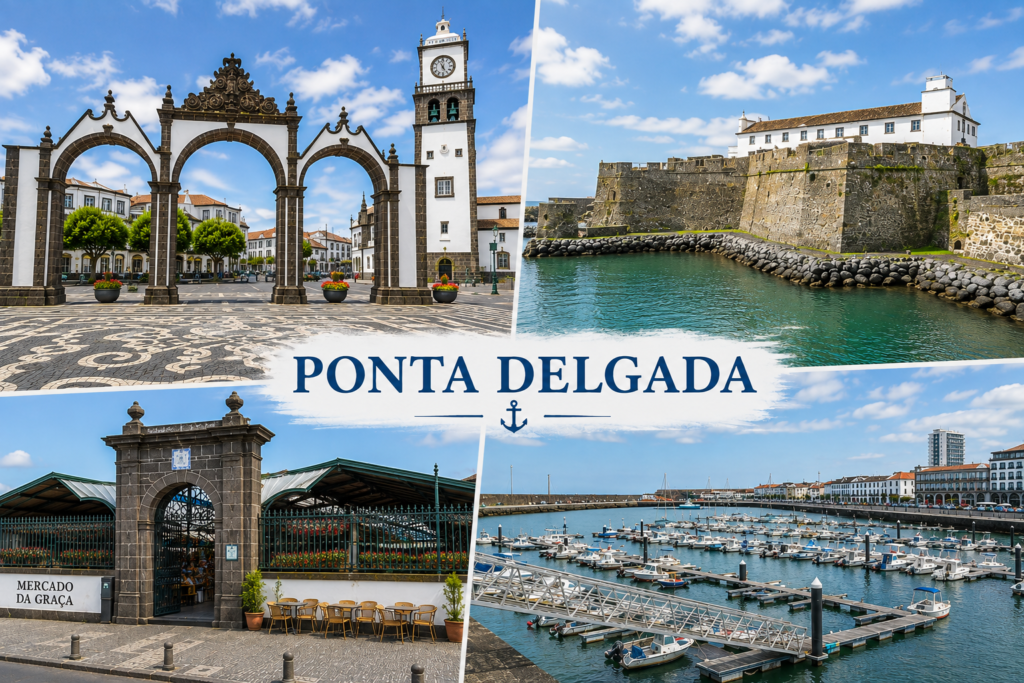
Ponta Delgada is often a visitor’s first introduction to São Miguel. Flights arrive here, many itineraries begin here, and this is where travellers first experience the contrast between city life and the constant presence of the Atlantic.
Yet Ponta Delgada should not be treated simply as the place where you collect a hire car or spend your first night. With volcanic-stone façades, churches, gardens, markets and streets leading towards the sea, the city deserves a few unhurried hours of exploration.
Knowing what to do in Ponta Delgada offers a better understanding of the island’s history and everyday life. This guide covers the essential sights, the best areas for food and the experiences worth enjoying before continuing across São Miguel.
Ponta Delgada is the largest city in the Azores and São Miguel’s main urban centre. Even so, it remains compact enough to explore comfortably on foot.
Many of the principal sights are close together in the historic centre. You can move between squares, churches, traditional shops and the seafront without relying constantly on a car.
The city also provides an interesting contrast to the rest of the island. After several days among volcanic lakes, waterfalls and scenic roads, Ponta Delgada offers a more urban experience without losing its connection to the Atlantic or its Azorean identity.
The City Gates, or Portas da Cidade, are one of Ponta Delgada’s best-known landmarks.
The three black-and-white stone arches stand beside Gonçalo Velho Cabral Square and mark the symbolic entrance to the historic centre.
From here, walk towards the Church of São Sebastião, admire the Portuguese pavement and explore the surrounding shopping streets.
The city’s main church stands out for its decorative façade and the volcanic stone used throughout its architecture.
Even travellers who rarely visit churches may enjoy stepping inside for a few minutes to appreciate the details and atmosphere.
Its central position makes it an easy stop during a walk around the City Gates.
Infante D. Henrique Avenue follows part of Ponta Delgada’s waterfront and offers one of the city’s most enjoyable walks.
The Portas do Mar area includes pedestrian spaces, restaurants, terraces and a marina. It feels lively during the day and becomes more relaxed towards evening.
Several marine excursions also leave from this area, including whale and dolphin watching trips.
São Brás Fort was built to protect the city and its harbour. Its imposing position beside the sea reflects Ponta Delgada’s historic and strategic relationship with the Atlantic.
The fort can be included in a walk between the waterfront and Campo de São Francisco.
Even without spending long inside, it provides useful context for understanding the city’s maritime history.
Campo de São Francisco is one of Ponta Delgada’s best-known squares.
It is home to the Sanctuary of Senhor Santo Cristo dos Milagres, associated with the largest religious celebration in the Azores. Outside the festival period, the square has a calmer, more open atmosphere.
Its trees, benches and surrounding historic buildings make it a pleasant place for a short break.
Mercado da Graça is one of the best places to experience everyday life in Ponta Delgada.
Built in the nineteenth century, the market continues to sell fresh fruit, vegetables, cheeses, fish and regional products. It is not simply a tourist attraction; local residents still use it regularly.
It is also an ideal place to discover ingredients that later appear on restaurant menus, including Azorean pineapple, cheese, jams, tea and local peppers.
A short distance from the centre, António Borges Garden offers a complete change of atmosphere.
Tall trees, artificial grottoes, winding paths and dense vegetation make the city feel surprisingly far away.
The garden is ideal for a quiet walk, a short break or part of a cloudy morning.
Several pineapple plantations near Ponta Delgada allow visitors to see how Azorean pineapples are traditionally grown inside glasshouses.
The visit is easy to include before leaving the city or when returning from a day elsewhere on the island. Visitors can observe the different growing stages and sample pineapple-based products.
Ponta Delgada offers one of the widest selections of restaurants in São Miguel. Choices range from traditional taverns and fish restaurants to contemporary dining and international cuisine.
Rather than choosing only the most photographed venues, consider the kind of experience you would like.
The centre is convenient for dinner after an afternoon of walking.
The streets near the City Gates, the main church and Campo de São Francisco contain restaurants, traditional taverns and modern spaces inside historic buildings.
This is a lively, practical area with options for different budgets.
The waterfront is particularly pleasant for a meal in a more open setting.
Restaurants and terraces serve fish, seafood and dishes inspired by Azorean cooking. The marina atmosphere makes this area especially appealing towards the end of the day.
The streets surrounding the market allow visitors to combine shopping for regional products with an informal lunch.
This is a good area for discovering local flavours and understanding the connection between island ingredients and Azorean cuisine.
When deciding where to eat in Ponta Delgada, look for some of São Miguel’s characteristic flavours:
Booking is advisable for popular restaurants during busier periods, particularly for dinner.
One full day provides enough time to visit the central sights, explore the market, walk along the waterfront and enjoy a relaxed meal.
With only a few hours, focus on the City Gates, the Church of São Sebastião, Mercado da Graça, the waterfront and Campo de São Francisco.
Travellers staying in Ponta Delgada can spread these visits across the trip. An evening walk or dinner in the centre fits easily after a day exploring other parts of the island.
Walking is usually the easiest option in the historic centre. The main sights are close together, while some streets are one-way or have limited parking.
Paid car parks are available near Mercado da Graça, Portas do Mar, Infante D. Henrique Avenue, Teatro Micaelense and other central areas. Free parking can also be found outside the busiest streets.
A practical solution is to park once and continue on foot. A car remains extremely useful, however, when using Ponta Delgada as a base for exploring the rest of São Miguel.
With Amazing Island, you can begin the morning in the city and change direction whenever you decide to continue towards a beach, volcanic lake or viewpoint beyond the original plan.
Yes. Although the central landmarks can be seen in a few hours, a full day allows time to explore the city slowly, visit the market and gardens, and enjoy the local food.
Ponta Delgada does not replace São Miguel’s natural landscapes. Instead, it adds a different dimension to the journey: history, local life and the feeling that the ocean is never far away.
Ponta Delgada is often treated merely as the gateway to São Miguel. Those who slow down discover a city of volcanic façades, lived-in streets, Azorean flavours and quiet moments beside the sea.
Then, when it is time to continue, simply choose a direction.
From Ponta Delgada, every road seems to lead towards a different version of São Miguel — and freedom begins when you leave enough space to change your plans.