

At first glance, a pineapple greenhouse might seem like a curious stop between São Miguel’s lakes, viewpoints and thermal springs. Then you step inside one.
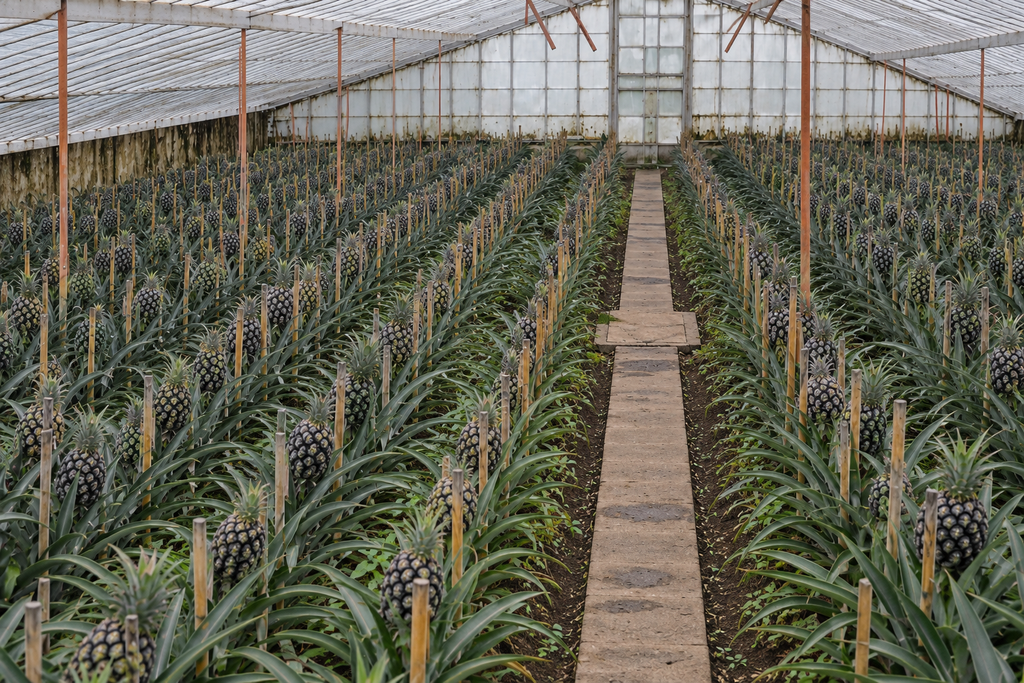
Under the glass, the atmosphere changes. The plants grow in close rows, the air is warmer and more humid and, depending on the greenhouse, pineapples can be at completely different stages of development. Some have barely begun to form; others already resemble the fruit we recognise from shops and markets.
What is most surprising, however, is discovering how much time lies behind each one. An Azorean pineapple takes around two years to complete its production cycle, using techniques developed over generations to grow a fruit associated with much warmer climates here on São Miguel.
Visiting one of the pineapple plantations in São Miguel is therefore about much more than seeing where a local product grows. It is a chance to discover part of the island’s agricultural history and understand how glass greenhouses, organic plant material, smoke and a great deal of patience turned pineapple into one of the Azores’ most distinctive products.
For much of the 19th century, oranges played an important role in São Miguel’s economy and were exported in large quantities, particularly to Britain. When disease caused a severe crisis in the island’s orange industry, alternative crops became increasingly important. Pineapple was one of them, alongside products such as tea and tobacco.
There was, however, an obvious challenge: São Miguel does not have a tropical climate. The solution was to develop a greenhouse production system, creating conditions that allowed the fruit to be cultivated in the island’s mild, humid Atlantic climate.
Over time, this became much more than an agricultural experiment. By the turn of the 20th century, pineapple had become an important São Miguel export. Today, Ananás dos Açores/São Miguel has Protected Designation of Origin status, with its geographical production area restricted to the island of São Miguel.
It is probably the first thing that surprises visitors. Instead of the large outdoor fields normally associated with tropical regions, São Miguel has traditional wood-and-glass greenhouses.
The process begins with traditional “hot beds”, using soil rich in organic matter whose fermentation helps to raise the temperature. This is where the first shoots develop from the planting material before the plants move through other stages and are eventually transplanted into the traditional glass greenhouses. The greenhouse glass can also be whitewashed to control the amount of sunlight reaching the plants.
Then there is a technique that tends to attract particular attention during a visit: smoking. At a certain stage, plant material is burned inside the greenhouse. The resulting smoke contains ethylene, which induces flowering and helps growers achieve a more uniform crop.
Once you understand the process, the roughly two years required to reach harvest no longer feels like just an interesting fact. Each fruit is the result of several stages, transplantations and interventions carried out over many months.
A visit does not necessarily take an entire morning or afternoon. That is precisely why the plantations fit so easily into a day in and around Ponta Delgada.
The most interesting part is walking through greenhouses at different stages of production. What might initially look like rows of similar plants gradually begins to make sense as you see different points in the growing cycle and understand why the process takes so long.
Do not necessarily expect to find hundreds of ripe pineapples ready to be picked either. A working plantation contains plants at different stages, and seeing that progression is part of the experience.
At some plantations, the visit can end with the opportunity to taste the fruit or products made from it. It is a good moment to notice something many visitors only discover once they try pineapple grown on the island: its balance between sweetness and acidity and its distinctive aroma are among the recognised characteristics of Ananás dos Açores/São Miguel PDO.
Fajã de Baixo, very close to Ponta Delgada, remains particularly associated with pineapple cultivation. There are several producers and plantations open to visitors, so adding one to your itinerary does not require a major detour.
The Augusto Arruda Pineapple Plantation in Fajã de Baixo is one of the best known. The property was previously associated with orange production before Augusto Arruda transformed it into an important pineapple plantation in the early 20th century. It has been open to visitors since 1919 and remains in the family.
During a visit, you can see different stages of cultivation inside the greenhouses and learn more about the techniques used in production. Admission is currently free and the plantation opens every day, although opening hours vary during the year.
Also close to central Ponta Delgada, the Azores Pineapple Plantation allows visitors to explore greenhouses at different stages of production independently. Information panels and QR codes explain the process, and visiting the greenhouses is currently free.
There are other plantations open to visitors in and around Fajã de Baixo, including the Santo António pineapple greenhouses, where visitors can see different stages of growth and taste the fruit.
Rather than trying to visit several plantations in one day, it makes more sense to choose one and spend some time understanding the process. Once you have seen greenhouses at different stages and understood the work involved, repeatedly visiting similar sites is unlikely to add as much as continuing to explore this part of the island.
Yes, particularly if you enjoy understanding the story behind local products. It is not an experience comparable to arriving at a vast volcanic lake or a dramatic viewpoint — and it does not need to be.
The scale is different. You step inside the greenhouses, see the plants up close and discover an agricultural method developed to adapt a tropical crop to the conditions found on São Miguel.
It is also an easy experience to include in an itinerary, particularly if you are staying in or visiting Ponta Delgada. Rather than taking up a large part of the day, it can be a stop between other places and add another dimension to your trip: for a while, São Miguel is no longer only about volcanoes, lakes and the ocean, but also about the crops that generations of islanders experimented with, adapted and perfected.
If you also visit the tea plantations in the Azores, there is an interesting connection between two crops now closely associated with São Miguel.
Both became important during a period when the island was looking for agricultural alternatives to oranges, but they followed very different paths. Tea found São Miguel’s mild, humid climate well suited to growing outdoors. Pineapple followed another route: production on the island developed inside greenhouses, using specific techniques that allowed this tropical crop to be adapted to Azorean conditions.
Seeing both reveals something larger than the story of two products. It shows how agriculture in São Miguel adapted to the island’s conditions and how some of those solutions are still visible in its landscape today.
As several plantations open to visitors are located in Fajã de Baixo and around Ponta Delgada, this is one of the easiest experiences to combine with a day in the city.
You can visit a plantation in the morning before heading elsewhere on the island, or save it for a part of the day when the weather is less inviting for viewpoints and lakes. Because the experience takes place largely inside greenhouses, it is less dependent on clear skies — no small advantage on an island where the weather can change quickly.
Having a car gives you even more freedom to make that combination without turning the plantation into a separate journey. With Amazing Island, you can stop when it makes sense along your route and then continue towards the coast, Ponta Delgada or another part of São Miguel.
The production cycle takes around two years. During that time, it passes through different stages and traditional techniques specific to this cultivation method are used.
It depends on the plantation, but some of the best-known sites currently offer free admission, including Augusto Arruda and the Azores Pineapple Plantation. Conditions can change, so it is worth checking before your visit.
Visiting arrangements vary between producers. Plantations offering self-guided visits do not generally state that individual visitors need to book in advance, although groups and specific tours should confirm directly with the plantation.
There is no single right choice. Augusto Arruda is one of the island’s best-known historic plantations and allows visitors to discover different stages of cultivation; there are also other plantations open to visitors in and around Fajã de Baixo. For a first visit, seeing different stages of the process matters more than trying to visit several plantations.
Some plantations have shops, kiosks or tastings where you can try the fruit and pineapple products. What is available varies between locations and throughout the year.
Perhaps that is the detail that stays with you most after visiting a plantation in São Miguel. You go in wanting to see where pineapples grow and leave thinking about how long it takes to produce a single fruit.
Over roughly two years, that pineapple has gone through a cycle involving different stages and transplantations, in an environment created specifically for this crop and using techniques refined over generations. What you later see at a market, in a restaurant or in a dessert no longer feels like just another regional product.
And when you finally taste a São Miguel pineapple, you already know a little of the story that came before the first slice.