

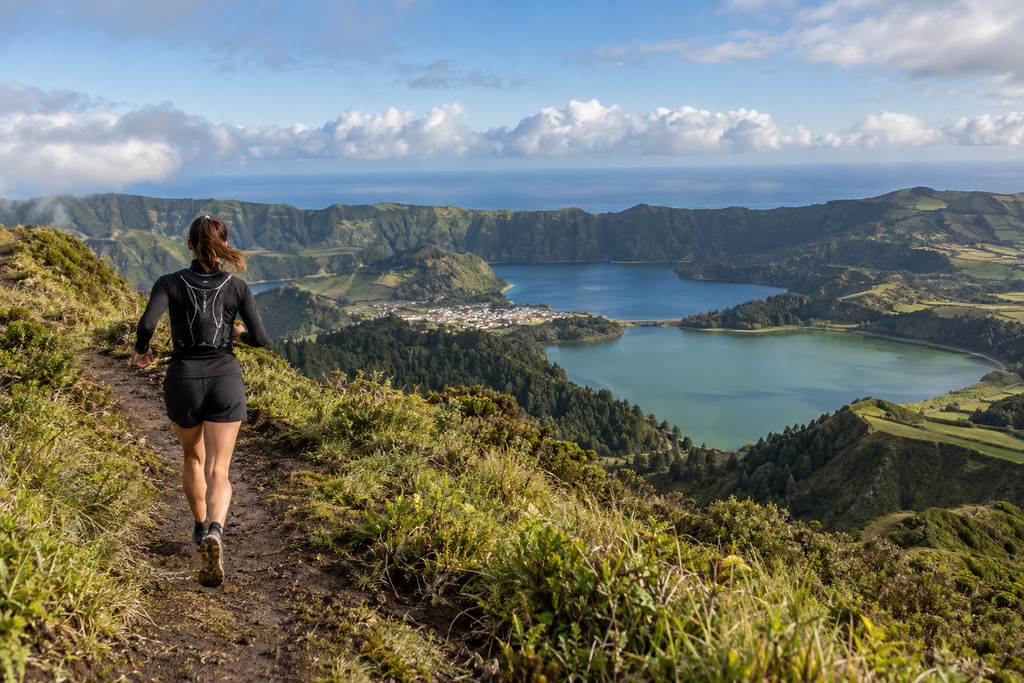
There are runs when you keep looking at your watch. In São Miguel, it is easy to forget about it for a while.
Along the ridges of Sete Cidades, the lake can appear on one side and the Atlantic on the other. In Nordeste, the trail enters a cryptomeria forest, climbs over damp ground and opens out onto the landscape again. Elsewhere, you can run beside volcanic lakes, cross pastureland or follow old paths between small villages.
It is this succession of different landscapes and terrain that makes trail running in São Miguel so interesting. The island is relatively small, yet its character changes constantly. For anyone who enjoys running off-road, that means volcanic, coastal, forest and mountain trails can all be part of the same trip.
The island’s geography does much of the work. São Miguel combines large volcanic calderas, mountainous areas, valleys, coastal cliffs, pastureland and extensive forests. The official walking trail network crosses many of these environments, giving trail runners an enormous variety of terrain within a relatively compact area.
One day you can run along a volcanic caldera. The next, you might choose a route beside the ocean. A few kilometres away, you can find yourself inside a forest where the ground, temperature and even the light feel completely different.
But there is something else you quickly realise: trail running in São Miguel is rarely just about running. Climbs, slippery descents, mud, roots and changes in gradient often mean alternating between running and walking. That irregularity is part of the experience.
Few places represent trail running in São Miguel quite as well as Sete Cidades.
The official Vista do Rei trail follows part of the caldera ridge before descending towards the village. It is 7.5 kilometres long and offers views across the caldera, the lakes and, at certain points, the island’s west coast.
For runners, there is one important detail: although the route is officially classified as easy for walkers, the final section of the descent is steep and can become slippery.
This is one of those places where it is difficult to separate the run from the landscape. Sometimes all it takes is looking up from the trail to appreciate the scale of the crater, with Lagoa Azul and Lagoa Verde far below.
At Lagoa do Fogo, the feeling is different. The landscape seems more isolated here, and signs of human activity gradually fade as the trail approaches the lake.
The official Praia–Lagoa do Fogo trail begins on the south side of the island and crosses agricultural and forested areas before reaching an increasingly natural landscape around the lake. For trail runners, part of its appeal lies precisely in these changes of terrain.
It is also a good example of why distance and elevation gain do not tell the whole story. Humidity, mud and rapidly changing weather can make a route considerably more demanding than the numbers suggest.
If you are looking for mountains and forest, Nordeste
offers another kind of experience.
At 1,105 metres, Pico da Vara is the highest point on São Miguel. The official trail through this area is classified as difficult and crosses forest and endemic vegetation before reaching the higher sections of the route.
Running here requires attention. The ground can be wet, the higher areas can disappear into cloud and some sections demand more control than speed. This is also where São Miguel reveals a particularly green and less urban side, very different from the busier areas along the south coast.
Not every route needs to be highly technical or demanding. In Furnas, you can run beside the lake through a landscape where geothermal activity, forest and everyday life coexist.
The official Lagoa das Furnas trail is circular and passes through the village, around the lake, through forested areas and past the geothermal vents. For anyone looking for a less demanding run or trying trail running while on holiday, this area offers a very different experience from the mountain routes.
And there is something particularly Azorean about finishing a run somewhere you can see steam rising naturally from the ground.
It is easy to associate trail running in São Miguel with lakes and mountains, but many routes also take you close to the coast. In several parts of the island, old paths cross cliffs, descend towards the sea or connect small villages.
Running here changes the feeling again: the wind becomes more noticeable, the landscape opens up and the Atlantic accompanies you for part of the route. This contrast between inland and coastal landscapes is one of the most interesting things about running in São Miguel.
You do not always have to choose between mountains and sea.
Trail running is not simply an activity for visitors. São Miguel has an active running community and established events that return to the island’s race calendar.
The 7 Cidades Ultimate Trail is one of the races most closely connected to its landscape. Its fifth edition took place in 2026, with routes crossing the caldera ridges, several lakes and some of the higher points around Sete Cidades. Distances ranged from roughly 10 km to a trail marathon.
The EPIC Trail Run Azores takes the idea much further. The 2026 event is its 11th edition and offers several distances, reaching 100 miles — 167 km. Its courses cross several municipalities, connecting volcanic landscapes, forest, mountains and coastline.
There is also the Trail dos Morcegos, another established event on São Miguel. Its 2026 edition takes place in September and includes Trail Sprint, Trail and Ultra Trail formats.
For those who enjoy racing, taking part in one of these events can be a completely different way to experience the island. Even if you prefer running alone, the events show just how much trail running has become part of São Miguel’s sporting culture.
As dates, distances and routes can change from one edition to the next, always check the official programme for the year you plan to travel.
Road runners are used to choosing their distance, pace and starting time. In São Miguel, there is another important variable: the weather.
It can be sunny by the coast and foggy in the higher areas. A trail that is dry one day can be extremely muddy the next. Rain, wind and humidity can quickly change how demanding the terrain feels.
Before setting out, always check the official trail status and the weather forecast. Carry enough water and food for the expected duration of your run, as well as a waterproof or windproof layer and a charged mobile phone. On more remote routes, sharing your planned route with someone is a simple precaution.
And if conditions are worse than expected, turning back is part of running safely.
Do not choose a route simply because the photograph looks impressive. Start with distance, elevation and terrain. Then consider your own experience and the forecast.
A runner comfortable with ten kilometres on the road may find the same distance very different when it includes long climbs, mud and technical descents. The official Azores Trails network provides information on distance, difficulty, estimated duration and trail status. It should be your main reference before setting out.
Having a car also makes this kind of trip much easier. With Amazing Island, you can reach different trailheads, adapt your plans to the conditions and combine a morning run with exploring another part of São Miguel.
Yes, but conditions vary considerably. Rain, mud, wind and fog can make some routes more demanding, particularly at higher elevations. Always check the forecast and official trail status before setting off.
Not necessarily. There are routes with different levels of difficulty. The key is choosing a distance and terrain that match your experience and remembering that running off-road can be considerably harder than covering the same distance on tarmac.
Many routes are used by both walkers and runners, but local rules and temporary restrictions should always be respected. Stay on the marked route and give priority to safety and other trail users.
Trail shoes with good grip are particularly useful. Depending on the route and conditions, also consider water, food, a windproof or waterproof layer, a charged phone and an offline copy of your route.
There are places in São Miguel that we see from a viewpoint. On the trail, we reach them in a different way.
We feel the gradient of the mountain, notice when the ground changes from stone to damp earth and, near the coast, sometimes hear the ocean before we can see it again. A distance that looked short on the map can take longer than expected — because of the terrain, the elevation and also because there are moments when it is worth stopping.
The goal may be to reach the end of the trail. But along the way, we end up discovering São Miguel in a completely different way.