

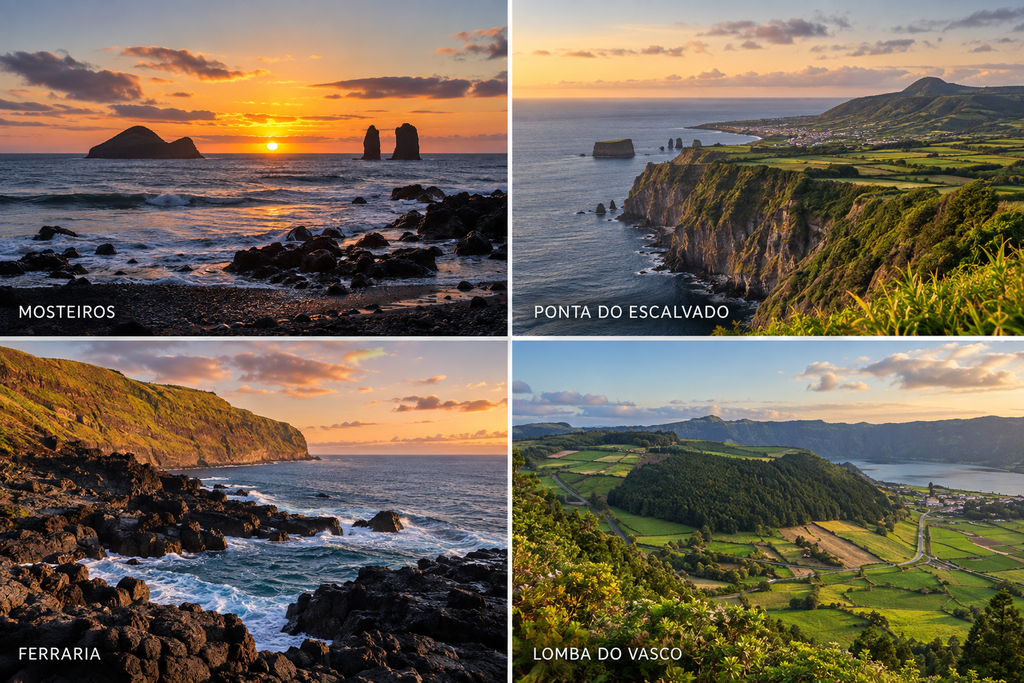
There is a time of day when São Miguel’s west coast takes on a different role. The lakes and mountains are behind you, the road moves closer to the Atlantic and the plan for the end of the afternoon can be as simple as choosing somewhere to stop and wait.
In Mosteiros, the sun sinks towards the ocean with the volcanic islets on the horizon. Higher up, Ponta do Escalvado opens onto a broad view of the western coastline. At Ferraria, the landscape changes completely: dark basalt, cliffs and ocean fill almost everything you can see.
There is no single right place to watch the sunset in São Miguel. Some days call for staying on the beach until the last light disappears; on others, a viewpoint on the way back is all you need. What matters is finding the place where the island’s orientation, landscape and time of day come together.
If we had to associate sunset in São Miguel with a single image, it would probably be this one: the Atlantic, the Mosteiros islets silhouetted on the horizon and the sun descending over the ocean.
Official Azores tourism information specifically highlights the Mosteiros islets at sunset, including the view of them from the more distant Ponta do Escalvado.
In the village itself, however, you are much closer. Mosteiros Beach lets you stay beside the sea, with dark volcanic sand and the islets ahead. Elsewhere along the coast, natural pools and basalt formations provide different perspectives on the same horizon.
It is worth arriving before the exact sunset time. The change begins earlier: the light drops, the rocks become more sharply defined and the sky may change several times before the sun finally disappears.
And there is no need to leave immediately afterwards. On days when the horizon remains clear, the minutes after sunset can be every bit as beautiful as the moment itself.
A few kilometres from Mosteiros, Ponta do Escalvado Viewpoint offers a different experience. Instead of being at sea level, you look across the coastline from above, with a wide view over western São Miguel.
From here you can see Mosteiros and its islets — precisely one of the landscapes highlighted by official Azores information when describing sunset on the island.
It is a good choice if you prefer a viewpoint to a beach, or if you are finishing a day around Sete Cidades and want to make the most of the last light before heading back.
The experience depends greatly on the conditions that day. With a clear sky, you can watch the sun approach the horizon directly. With some cloud, the light can become even more interesting. And, as so often happens in São Miguel, low cloud or mist can arrive suddenly and completely change the scene.
That is part of the island.
At Ponta da Ferraria, the setting changes again. Here, the volcanic coastline takes centre stage: black rock, cliffs and a lava platform stretch towards the Atlantic.
The area is best known for its natural pool, where seawater is warmed by volcanic thermal springs. The official Pico das Camarinhas–Ponta da Ferraria trail crosses this landscape and reveals several of the area’s volcanic geological features.
At the end of the day, however, you do not need to enter the water to make the journey worthwhile. Its open position facing the ocean and its volcanic landscape make Ferraria an excellent place to watch the sun descend, particularly if you are already exploring this part of the island.
If you want to combine sunset with a swim in the natural pool, there is one important detail: the warm-water experience depends on the tide, with low tide being the reference point for feeling the effect of the thermal springs most strongly. Check the tides and sea conditions rather than planning the swim around sunset alone.
Near Sete Cidades, there is another interesting option that is less commonly associated with the island’s classic sunset photographs: Lomba do Vasco Viewpoint.
The viewpoint overlooks the west coast, Mosteiros and its islets. It can also be reached via a short detour from the official Vista do Rei–Sete Cidades walking route.
Here, the appeal is largely about perspective. Instead of seeing the islets close up, you can appreciate how Mosteiros sits within the coastline and how the slopes descend towards the Atlantic.
It is a particularly good alternative if you have spent the day around Sete Cidades and want to finish with an ocean view without necessarily driving all the way down to the coast.
Sete Cidades often appears in late-afternoon photographs, and for good reason. The crater rim offers expansive views, while some areas reveal both the interior of the caldera and the approach towards the west coast. The Vista do Rei trail, for example, follows the south-western side of the Sete Cidades ridge before descending towards the village.
But there is an important distinction: Sete Cidades can be extraordinary in late-afternoon light, but the lake itself would not automatically be my choice for watching the sun disappear over the horizon.
The topography of the caldera changes the experience. If your specific aim is to watch the sun set over the Atlantic, continuing towards Mosteiros, Escalvado or another open point on the west coast makes more sense.
If what you want instead is low evening light across the slopes and lakes, finishing the day around the crater rim can be an excellent choice.
You do not need to cross the entire island every time you want to enjoy the end of the day. The coastline west of Ponta Delgada also offers open views towards the Atlantic, particularly around Feteiras and Ginetes.
Near Feteiras, for example, the Vigia da Baleia viewpoint has broad views over São Miguel’s southern coast. The site is also connected to the island’s whaling history: whale spotters once used it to locate sperm whales at sea, while today it is associated with whale-watching activity.
It may not have the instantly recognisable silhouette of the Mosteiros islets, but it can make far more sense if you simply want to end the day beside the Atlantic without adding a long detour to your itinerary.
Choosing the location is only half the decision. In São Miguel, the weather often decides the other half.
A completely clear sky may give you the classic sunset, with the sun itself approaching the horizon. A few clouds, however, can create even more interesting colours and contrasts. The problem comes when low cloud or mist hides the coast entirely.
Rather than deciding in the morning that you must watch sunset from one particular place, it is worth keeping some flexibility. Watch how the sky develops during the afternoon and, if you have a car, adapt your plan.
This is exactly the kind of moment when having the freedom to move around São Miguel makes a difference. Sometimes a relatively small change of location is enough to find completely different conditions.
Sunset time changes considerably throughout the year, so there is little value in giving a fixed hour. Summer days are significantly longer, while in winter the sun disappears much earlier.
Check the sunset time for the specific date of your visit and try to arrive 30 to 45 minutes beforehand. That gives you time to park, choose your spot and watch the gradual change in the light rather than arriving only for the final few minutes.
It is also worth staying for a while after the sun disappears. Depending on the clouds and atmospheric conditions, some of the strongest colours can appear after the sun has already passed below the horizon.
For the most characteristic view, Mosteiros is probably the obvious choice, particularly because of the islets on the horizon.
If you prefer seeing the coastline from above, choose Ponta do Escalvado. For a more volcanic landscape dominated by basalt, Ferraria offers something completely different. Lomba do Vasco works particularly well if you are already around Sete Cidades, while Feteiras can be a practical option for ending a day closer to Ponta Delgada.
There is no need to try to see sunset from all of them. There is something slightly contradictory about turning the slowest moment of the day into a race between viewpoints.
Choose one. Arrive early. And stay.
Mosteiros and Ponta do Escalvado are among the most characteristic choices because of their position on the west coast and their views towards the Mosteiros islets. The best option, however, depends on your itinerary and the weather conditions that day.
They offer different experiences. At Mosteiros, the islets create a distinctive silhouette against the ocean. At Ferraria, the landscape is dominated by basalt, cliffs and the volcanic origins of the coastline.
Yes, particularly for the late-afternoon light across the crater and lakes. If your specific aim is to watch the sun disappear over the Atlantic, open viewpoints along the west coast generally offer a more direct perspective.
Around 30 to 45 minutes before sunset is a good margin. It gives you time to park and watch the landscape change as the light gradually drops.
It would not be my choice for sunset. Ponta da Madrugada and Ponta do Sossego are in Nordeste and are officially highlighted as particularly good places to watch the sunrise.
After a day exploring São Miguel, it is easy to keep thinking about what you have not yet seen. One more viewpoint, another lake, one last stop before heading back.
Sunset can be the opposite. Choose somewhere, switch off the engine and stay for a while with no other objective than watching the light change over the Atlantic.
At Mosteiros, it may be the islets defining the horizon. At Ferraria, the basalt. At Escalvado, the entire western coastline stretching out in front of you. The setting changes, but perhaps the best part remains the same: for a few minutes, there is nowhere else you need to be.