

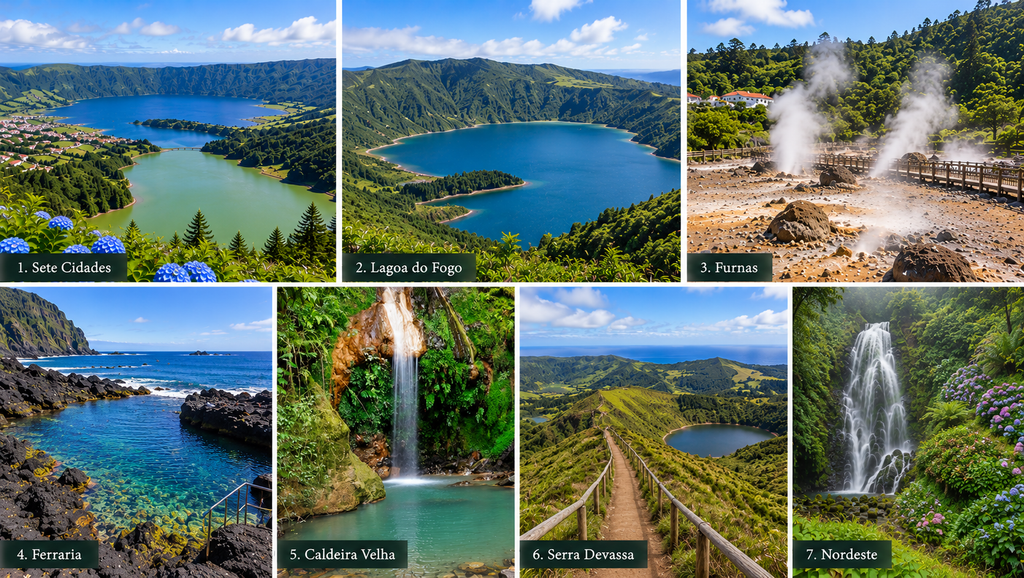
In São Miguel, you do not have to travel far to feel as though the landscape has changed completely. Some roads cross green pastures before reaching valleys where steam rises from the ground. Lakes hidden among mountains, mist-covered forests and stretches of black volcanic rock beside the Atlantic all belong to an island where the surroundings seem to change around every bend.
This diversity is what makes São Miguel’s landscapes so remarkable. The island’s volcanic origins explain much of its terrain, but the climate, vegetation and proximity to the ocean create contrasts that are not always expected in such a relatively small area.
Some of these places are familiar to almost every visitor, while others receive less attention. Yet, despite their differences, they have something in common: they make you stop for a moment and try to understand what you are seeing.
In Furnas, São Miguel’s volcanic origins are impossible to ignore. Steam rises from fumaroles, water bubbles in geothermal springs and the smell of sulphur accompanies visitors through parts of the valley. These natural features coexist with gardens, houses, roads and the everyday life of the village.
Near Furnas Lake, heat from the ground is also used to prepare the traditional Cozido das Furnas, cooked in pots buried in the earth for several hours. This connection between geothermal activity and local life is one of the most interesting characteristics of the area.
Perhaps the most surprising feature, however, is the contrast. Just a few minutes from the fumaroles, you find lush vegetation, gardens and the peaceful surroundings of the lake. The same valley that reveals the energy beneath the Earth’s surface also offers some of the greenest scenery on the island, showing how volcanic activity remains part of the present while coexisting with nature and everyday life.
Located within the caldera of the Fogo Volcano, the lake is surrounded by steep slopes and vegetation that follows the natural contours of the terrain. There are no large buildings along its shores, adding to the sense of isolation when looking across the landscape.
From the viewpoints, the scale of the surroundings becomes clear. The colour of the water changes with the light, while the slopes descend towards the lake, creating a setting that feels far removed from everyday life. On clear days, you can distinguish the different landforms and appreciate the size of the caldera.
Because of the altitude, however, clouds and mist are frequent. Some days the lake disappears completely; on others, it emerges briefly between passing clouds, making the visit quite different from what you might have imagined.
It is one of São Miguel’s defining characteristics: even a place you know well from photographs can look entirely different depending on the conditions when you arrive.
From Vista do Rei, you look down towards the Blue and Green Lakes, surrounded by the slopes of an enormous volcanic caldera. It is one of the Azores’ best-known views, but the landscape takes on another dimension when you explore the crater rim and begin to understand the scale of the surrounding terrain.
In some places, you can see into the caldera and, shortly afterwards, towards the slopes descending to the Atlantic. The lakes, pastures and different landforms reveal how this part of the island has been shaped over time, creating changing perspectives as you travel through the area.
There is also something particularly interesting about the village of Sete Cidades, located inside the caldera. Houses, farmland and roads are part of a landscape with profoundly volcanic origins. This coexistence between the scale of the natural setting and everyday life helps explain why Sete Cidades is so distinctive, beyond the famous image of its two lakes.
At Ponta da Ferraria, dark basalt dominates the coastline, creating an irregular landscape of volcanic rocks, cliffs and a lava platform extending towards the Atlantic. Vegetation is far less prominent here than elsewhere in São Miguel, leaving the formations created by volcanic activity exposed.
The sea moves between the rocks, and waves break against a coastline where the influence of lava on the shape of the land is clearly visible. Ferraria is also home to one of the island’s most unusual natural experiences: an ocean pool where seawater mixes with water heated by geothermal springs.
The water temperature varies with the tide and sea conditions. Strong swell can make the natural pool dangerous, so any swim must take the state of the sea and local safety guidance into account.
Even without entering the water, it is worth exploring the permitted access paths and observing the basalt formations. Ferraria offers a particularly clear example of how lava reaching the ocean helped create a coastline so different from the green hills normally associated with the Azores.
Located on the slopes of the Fogo Volcano, Caldeira Velha combines thermal springs, warm-water pools, rocks of different colours and dense vegetation. It is a more enclosed environment than Furnas, where geothermal activity is integrated into an inhabited valley.
Here, steam mixes with the humidity of the forest as water flows over the rocks. In places, trees and ferns almost completely surround the pools, creating a landscape where water and vegetation are just as prominent as the geothermal activity itself.
This combination reflects the natural conditions of the area, where geothermal heat, a humid climate and vegetation coexist within a relatively small space. Caldeira Velha therefore reveals another expression of São Miguel’s volcanic character, very different from the exposed basalt of Ferraria or the fumaroles of Furnas.
Serra Devassa is one of the places where São Miguel reveals a less obvious side. Instead of one large lake surrounded by an imposing caldera, you find smaller lakes scattered among volcanic hills, wetlands and low vegetation.
Lagoas Empadadas and Lagoa do Carvão form part of this landscape, alongside Pico das Éguas and other elevations that can be seen along the area’s walking routes. It is particularly interesting for those who enjoy walking and discovering places without a constant succession of major viewpoints or tourist facilities.
Mist can completely transform the atmosphere. Lakes appear and disappear among the clouds, the hills lose their definition and, at times, it becomes difficult to tell where one slope ends and another begins. On clear days, however, the succession of small lakes and hills can be seen in remarkable detail.
Serra Devassa does not have the grandeur of Sete Cidades or the geothermal activity of Furnas. Its appeal lies in a quieter landscape that gradually reveals itself to those who take the time to explore it and observe its different natural features.
In Nordeste, the hillsides become more deeply cut, valleys are steep and some forested areas are so dense that vegetation seems to fill almost every available space. It is a region shaped by humidity and varied terrain, with environments very different from the open pastures elsewhere in São Miguel.
Around Tronqueira, for example, extensive stands of Japanese cedar, or cryptomeria, have adapted to the island’s humid conditions. Alongside these introduced forests, important areas of native and endemic vegetation remain, supporting the conservation of species such as the Azores bullfinch, known locally as the priôlo.
As you travel through some of these areas, the light fades beneath the trees and the surroundings become more enclosed. The ground often remains damp, and the density of the vegetation means the landscape reveals itself gradually, particularly along roads and paths crossing the forests.
Nordeste shows that São Miguel’s diversity cannot be explained by volcanoes and lakes alone. Forests, altitude, humidity and terrain also create distinctive places where the feeling of remoteness can be just as striking as the view across a great caldera.
The explanation begins with the island’s volcanic formation. São Miguel developed through the evolution of different volcanic systems, creating calderas, cones, lava flows and other geological formations. Over thousands of years, erosion, water, climate and vegetation have continued to transform these structures.
That is why places with similar geological origins can look so different. In Furnas, you can observe geothermal activity; at Lagoa do Fogo and Sete Cidades, large calderas dominate the landscape; at Ferraria, lava shaped the coastline; and in Serra Devassa, smaller lakes and volcanic hills create a more fragmented landscape.
Altitude and exposure to the Atlantic add another dimension. Higher areas are often covered in cloud and mist, while coastal locations may have completely different weather conditions at the same time. In São Miguel, it is not only the landscape that changes from place to place: sometimes the same setting transforms throughout the day.
Although São Miguel is a relatively small island, trying to visit all these places in one day is not a good idea. Some areas naturally fit together, making it possible to organise balanced routes without spending too much time on the road.
Lagoa do Fogo and Caldeira Velha are in the central part of the island, while Sete Cidades and Serra Devassa can be included in a route through the west. Ferraria also fits easily into a west coast itinerary, particularly if you are exploring Mosteiros or Ginetes.
Furnas deserves time to explore the valley and the surroundings of the lake. Nordeste can take up much of a day, especially if you want to drive through forested areas and stop at different viewpoints.
The weather is another important consideration. A misty day in the mountains may be a good opportunity to explore the coast, leaving the lakes for clearer conditions. Having a car makes that flexibility much easier and allows you to adapt your route to the island’s conditions rather than following a rigid itinerary.
With Amazing Island, you can organise your days at your own pace and discover São Miguel’s different landscapes with the freedom to adjust your plans. After all, part of the island’s appeal lies in what you discover between the places you originally planned to visit.
Some of the most distinctive include Sete Cidades, Lagoa do Fogo, Furnas, Ferraria, Caldeira Velha, Serra Devassa and the forests of Nordeste. Each reveals a different aspect of the island’s volcanic origins and natural environment.
Many of the lakes occupy depressions associated with volcanic activity, including calderas and craters. Water accumulating in these formations created some of the island’s best-known landscapes.
Generally, yes, although weather conditions and occasional access restrictions may affect some visits. It is advisable to check conditions on walking routes, at viewpoints and in protected areas beforehand.
Early morning and late-afternoon light can be particularly attractive, but the weather is often the deciding factor. In higher areas, clouds may completely obscure the scenery regardless of the time of day.
Not necessarily, but a car makes travelling between different areas much easier, particularly when you need to adapt your plans to changing weather conditions.
After a few days in São Miguel, you begin to realise that no single image can represent the whole island. The lakes of Sete Cidades, the fumaroles of Furnas, the black coastline of Ferraria and the small lakes of Serra Devassa all belong to the same place, yet they could hardly look more different.
And perhaps that is the greatest surprise. São Miguel does not need imaginary landscapes or exaggerated comparisons to impress. You simply need to follow its roads, notice how the terrain changes and leave a little room in your itinerary for the unexpected.
Because on this island, there is always the possibility of discovering something completely different just around the next bend.