

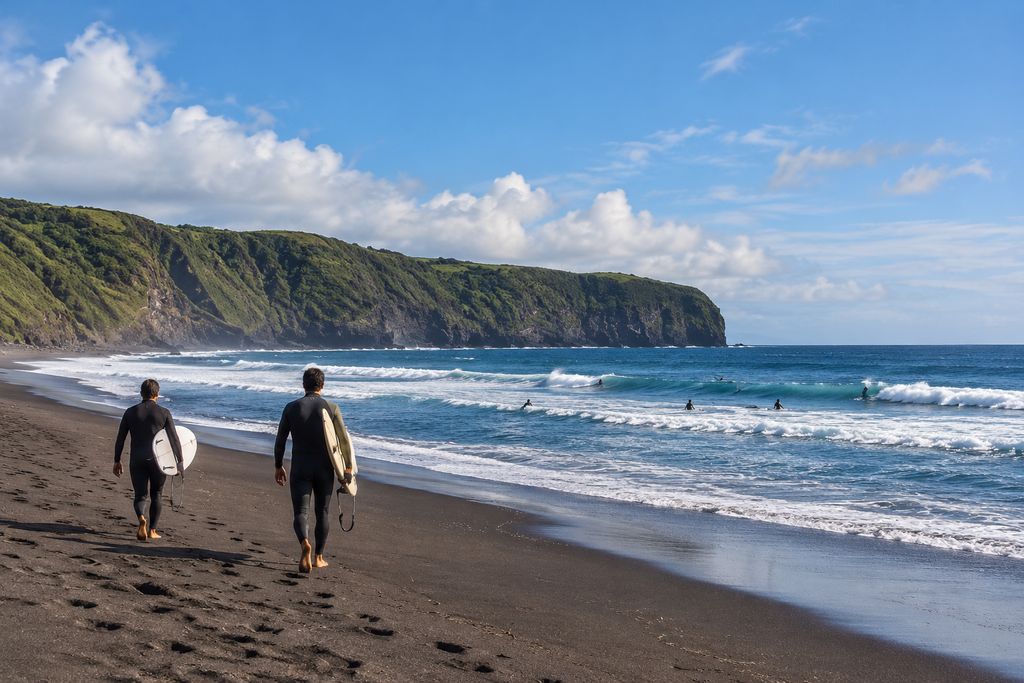
On some days in São Miguel, you only need to reach the north coast to realise that surfing has become part of the landscape.
Around Ribeira Grande, boards leaning against cars, wetsuits drying in the sun and surfers standing on the beach checking the waves are a familiar sight. At Santa Bárbara Beach, Atlantic waves roll towards a long stretch of dark volcanic sand, with green hills rising behind it. Yet drive across the island and you can find a different coastline, different wind exposure and completely different conditions.
That variety is one of the reasons why surfing in São Miguel is attracting more and more visitors.
The island is not simply somewhere that happens to have waves. It is a place where surfing can be combined with volcanic landscapes, hot springs, towns and nature — even if you have never stood on a surfboard before.
São Miguel sits in the Atlantic and has a remarkably varied coastline.
Volcanic beaches, rocky sections, bays and coastlines facing different directions create very different conditions around the island.
One of its great advantages is the ability to look for different conditions without travelling huge distances. If one coast is too exposed to wind or swell, another part of the island may offer an alternative.
For local surfers, checking the forecast and deciding where to paddle out is simply part of the routine. For visitors, it means surfing can fit naturally into a wider trip rather than requiring an entire holiday to revolve around a single beach.
If there is one place where surf culture is particularly visible, it is Santa Bárbara Beach, near Ribeira Grande.
Its dark sandy beach stretches for roughly one kilometre and has several peaks, creating different surfing areas along the shore. It has also hosted international surfing and bodyboarding competitions.
But Santa Bárbara is interesting even when there is no competition taking place.
On an ordinary day, you might see local surfers, visitors, surf schools preparing boards on the sand and people simply sitting and watching the waves.
Even if you do not surf, it is worth stopping here.
And because the beach is close to Ribeira Grande, it is easy to combine a few hours by the ocean with the historic centre or lunch in town.
Just a few minutes away is Monte Verde Beach.
It is less familiar to many first-time visitors, but well known among people who practise wave sports on the island.
There are several peaks, with both left- and right-breaking waves. Conditions change considerably according to swell, wind, tide and the shape of the sandbanks, meaning the same beach can behave very differently throughout the year.
It is also a good example of why choosing a surf beach simply because it appears on an online list is not particularly useful.
In surfing, the best spot always depends on the conditions that day.
When people think about surfing in São Miguel, the north coast — particularly Ribeira Grande — tends to dominate the conversation.
But it is not the only option.
Beaches including Pópulo, Milícias and Água d’Alto may be used by surf schools and surfers when conditions are more suitable on the southern side of the island.
Being able to switch between coasts is one of São Miguel’s most useful characteristics for surfers.
As a visitor, it also means you do not need to decide months in advance exactly where you will surf. Checking the forecast closer to the day — or allowing a surf school to choose the best location if you are a beginner — makes far more sense.
At the western end of the island, Mosteiros reveals another side of the Azorean coast.
Black sand, volcanic rock and the distinctive islets offshore create a completely different setting. Surfing is possible here too, but rocky sections and different wave types mean some spots are very different from the sandy beaches around Ribeira Grande.
It is a useful reminder that not every surf spot should be approached in the same way.
If you do not know the area or lack the experience to assess currents, conditions and safe entry points, do not choose a wave simply because it looks appealing from the road.
Yes — and you do not need to organise an entire surfing holiday to do it.
Several surf schools operate in São Miguel, offering lessons and equipment hire. Some choose the beach according to the conditions on the day, moving between the north and south coasts when necessary.
For beginners, this is probably the best approach.
Instead of trying to interpret swell, wind, tides and currents yourself, you have someone who knows the local beaches and can select an area appropriate for your level.
And there is something distinctive about learning to surf in São Miguel. When you lift your head from the board, you are not looking at the Atlantic alone. Green slopes, volcanic cliffs or dark sand are often part of the view.
There is no single answer because it depends heavily on your ability and the kind of waves you are looking for.
Atlantic swell reaches the islands throughout the year, but wave size, swell direction, wind and sea conditions vary considerably between seasons and even from one day to the next.
For beginners, finding conditions suited to your level matters more than chasing a particular “surf season”.
Experienced surfers can plan more closely around forecasts and the different exposures around the island.
Either way, flexibility helps.
This may be one of the biggest differences between São Miguel and destinations built almost entirely around surfing.
Here, you do not have to choose between having a surf holiday and exploring the island.
You can surf at Santa Bárbara in the morning, have lunch in Ribeira Grande and finish the day in a thermal pool. Or wait for suitable conditions at sea while exploring a volcanic lake, viewpoint or another part of the coast.
Having a car makes this kind of trip much easier. With Amazing Island, you can adapt your route to the sea conditions while continuing to discover São Miguel away from the water.
Surfing becomes part of the journey rather than something that limits it.
Yes, provided the conditions are appropriate and ideally with a surf school. There are beaches and sections used for beginners, but sea conditions should always be assessed on the day.
No. Surf schools and operators offer lessons and equipment hire, so you can easily try surfing during your holiday without travelling with your own board.
It is the beach most strongly associated with surfing in São Miguel and has several peaks, but no beach is always the best option. Wind, swell and tides may make another part of the island more suitable on a particular day.
Surfing takes place throughout the year, although conditions vary considerably. For beginners, the priority should be finding waves appropriate for their experience rather than choosing a season simply because the swell is larger.
Surfing offers another way to experience São Miguel.
After spending several days looking at the Atlantic from viewpoints, beaches and coastal roads, entering the water changes the perspective.
The island sits behind you, the slopes suddenly seem larger and, for a while, there is only the movement of the ocean and the next wave.
Perhaps that is part of the reason more surfers are discovering São Miguel.
Not only for the waves, but for everything waiting when they come back out of the water.