

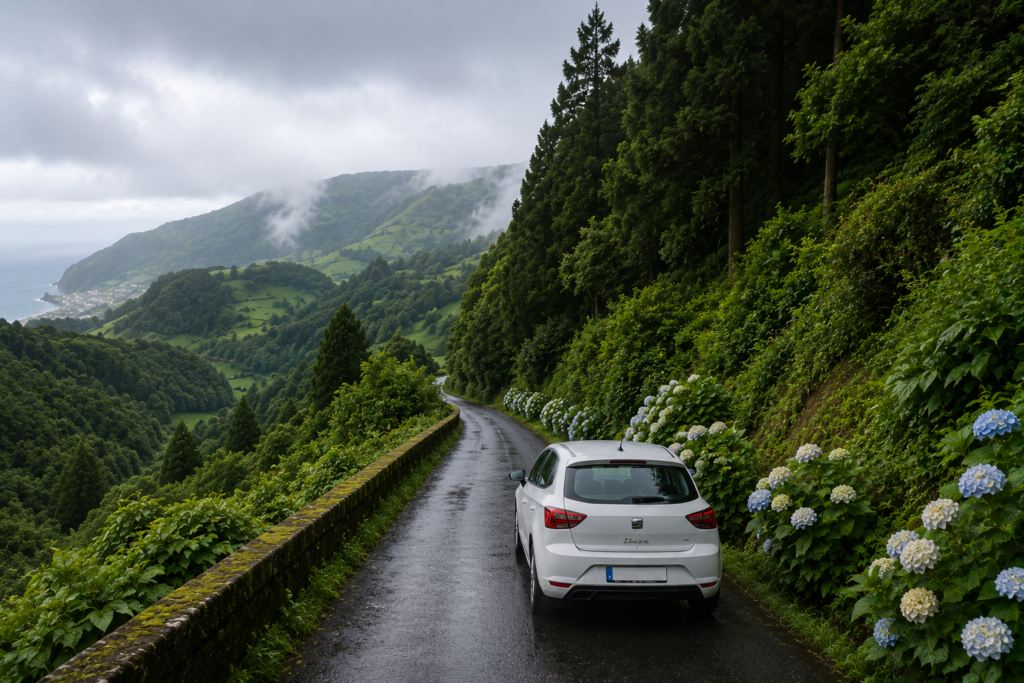
Some parts of São Miguel make an immediate impression. Nordeste works more quietly.
Here, the landscape feels deeper, the cliffs appear higher and the greens somehow seem more intense. Roads pass through small villages, dense woodland and viewpoints where the only sound may be the wind moving through the trees.
Nordeste lies in the easternmost part of the island, away from the busiest areas around Ponta Delgada. That distance has helped it retain a slower, more rural atmosphere than many of São Miguel’s best-known destinations.
A visit to Nordeste should not simply be a race between landmarks. It is a place to drive slowly, stop when the view changes and discover a quieter side of the island.
The municipality occupies the oldest geological section of São Miguel. The Nordeste Volcanic Complex is approximately four million years old and includes Pico da Vara, the island’s highest point. Its ancient terrain has created a rugged landscape of mountains, deep valleys, streams and steep coastal cliffs.
Nordeste also protects some of the Azores’ most important native vegetation. The slopes around Pico da Vara contain areas of Laurissilva forest, with endemic species including Azorean holly, juniper, laurel and heather.
Visitors do not need to understand the geology or identify every plant to notice the difference. It can be felt while driving through light mist, watching waterfalls emerge between the trees and passing villages tucked into the mountains.
Ribeira dos Caldeirões is one of Nordeste’s most popular attractions, and deservedly so.
The park follows a stream through lush vegetation, waterfalls and a collection of restored watermills. For generations, these mills were an important part of local life, using the force of the water to support families living in the parish of Achada.
It is an easy place to explore, whether you want to take a short walk, rest among the gardens or see the main waterfall.
Specialist outdoor companies also use the Ribeira dos Caldeirões area for canyoning.
Few places suit their name as well as Ponta do Sossego — the Point of Tranquillity.
Its landscaped gardens extend across several terraces overlooking the eastern coastline. Covering around 13,000 square metres, it is one of the most recognisable viewpoints in Nordeste.
There are flowerbeds, picnic areas and uninterrupted views of the Atlantic. In spring and summer, the gardens become particularly colourful, although the coastline makes this a worthwhile stop at any time of year.
This is not a viewpoint to photograph and leave immediately. Walk through the different terraces and allow time simply to look at the landscape.
A short drive from Ponta do Sossego is another of the east coast’s most beautiful viewpoints.
Ponta da Madrugada is especially well known as a sunrise location. Facing east over the Atlantic, it offers a clear view of the first light appearing above the ocean, and some visitors arrive before dawn specifically for the experience.
It remains a rewarding stop later in the day, when the view reveals the scale of Nordeste’s cliffs and deeply cut coastline.
Opened in 1876, Arnel was the first lighthouse built in the Azores. It stands on a steep headland beside Nordeste’s small fishing harbour.
One of the best views is from the Vista dos Barcos viewpoint, where the white lighthouse appears below against the deep blue Atlantic.
The road leading down is exceptionally steep. Most visitors will find it safer to park at the top and continue on foot only when their fitness, footwear and the weather conditions allow.
Nordeste town is small, tidy and easy to explore on foot.
You can walk through the centre, see the Seven Arches Bridge and spend a little time in the gardens and streets lined with traditional Azorean buildings.
There is no need for a long list of monuments. Part of its charm lies in watching everyday life, enjoying the absence of crowds and stopping for coffee or lunch before continuing along the coast.
The municipality contains some of São Miguel’s most rewarding — and demanding — walking routes.
The Pico da Vara trail reaches the highest point on the island, approximately 1,100 metres above sea level. It crosses protected landscapes around Serra da Tronqueira and the Graminhais plateau. This is a mountain route where visibility and weather conditions may change quickly, so preparation is essential.
For a gentler introduction to the area, the circular Lomba da Fazenda route passes several local points of interest and provides a closer look at one of the municipality’s rural parishes.
Official trails may occasionally close because of weather, maintenance or safety conditions. Always check the Azores Trails platform before setting out.
Set aside a full day for Nordeste.
Distances may appear modest on a map, but winding roads, changing weather and frequent viewpoint stops make the journey slower than expected.
A comfortable day could include:
Trying to fit Nordeste into a rushed morning would mean missing the quality that defines it: having enough time to stop.
Travelling by car is the most practical option.
It allows you to stop at viewpoints, adapt the route to the weather and reach rural areas that are difficult to explore efficiently by public transport.
One option is to approach along the north coast, passing Ribeira Grande and Achada, before returning through Povoação and Furnas. This creates a panoramic circuit around much of eastern São Miguel.
Check the forecast before leaving, but avoid planning every stop to a rigid schedule. Clouds can hide a viewpoint completely and then clear only a few minutes later.
Yes. It is one of the best parts of São Miguel for green landscapes, coastal viewpoints, waterfalls and a quieter atmosphere.
Yes. A full day is enough to see the principal sights without turning the trip into a rushed sequence of stops.
It is not strictly essential, but a car is by far the most convenient option. The attractions are spread across the municipality, and driving gives you more freedom to respond to changing weather.
Nordeste can be visited throughout the year. Spring and summer bring longer days and colourful gardens, while autumn and winter often give the waterfalls more force and make the vegetation appear especially intense.
Ponta da Madrugada is one of São Miguel’s best-known locations for watching the sun rise above the Atlantic.
Nordeste does not need a collection of major attractions to make an impression.
Its appeal comes from the combination of mountain forest, waterfalls, quiet villages, dramatic cliffs and the Atlantic almost constantly appearing on the horizon.
With an Amazing Island hire car and a day that is not governed by a strict timetable, you can explore this remote side of São Miguel freely, stopping whenever the landscape deserves a little more time. Perhaps it is from the silence of a viewpoint in Nordeste that São Miguel reveals its greenest landscapes — and its most peaceful rhythm.